REVIEW · LAS VEGAS
Audio Driving Tour: Grand Canyon West, Hoover Dam Red Rock Canyon
Book on Viator →Operated by GuideAlong (GyPSy Guide) · Bookable on Viator
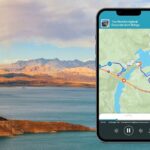
Las Vegas to the Canyon, on your own schedule is the point. This audio driving tour strings together big-ticket sights like Hoover Dam and Grand Canyon West with a smart trick: the narration follows your GPS location, so you hear the right story at the right moment. You can keep it simple with a quick highlights run, or stretch it into a multi-stop day that fits how you like to travel.
I especially like the offline GPS approach. Once you download the tour, it keeps working when cell service disappears, and it gives you turn-by-turn guidance tied to where you are. I also love the flexible pacing. You can pause, skip forward, or linger at overlooks without feeling like you’re trapped in someone else’s itinerary.
One drawback to watch: if you start the app after you’ve moved around a lot (like after lunch), the GPS syncing can feel flaky. My advice is straightforward: set up the download before you leave, then start the tour while you’re near the route.
In This Review
- Key takeaways before you hit the road
- Price and what you’re really paying for
- How the GuideAlong offline GPS audio keeps you on track
- A quick note on syncing
- Where to start in Las Vegas (and why it matters)
- Stop 1: Las Vegas as your planning hub
- Stop 2: Hoover Dam up close (and why the walk is the whole point)
- Stop 3: Hoover Dam Bypass bridge views with a science lesson
- Stop 4: Grand Canyon West Skywalk (glass floor, big nerves optional)
- Stop 5: Guano Point—canyon views plus mining-cave texture
- Stop 6: Eagle Point—legends in the rock shape
- Stop 7: Red Rock Canyon’s 13-mile loop (and the petroglyph bonus)
- Stop 8: Spring Mountain Ranch State Park—history with real buildings
- Stop 9: Ethel M Chocolates Factory and Cactus Garden—sweet break, solid story
- Stop 10: Lake Mead viewpoint—fast payback for a short stop
- Stop 11: Boulder City—planned housing, no gambling
- The best way to use the route planner (without turning it into homework)
- What I think this audio driving tour is best for
- Final call: should you book this audio tour?
Key takeaways before you hit the road
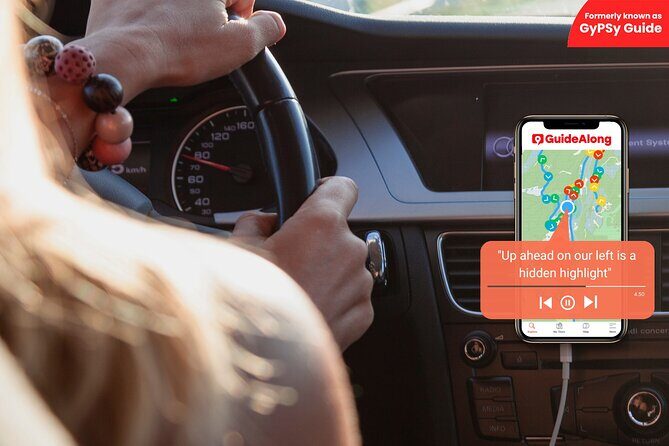
Offline-first design means you can tour even with no cell service once the audio is downloaded.
Location-based autoplay plays stories and tips automatically as you pass key points.
A low group price covers up to 8 people in your vehicle, so the per-person cost drops fast.
Grand Canyon West includes shuttle access between Eagle Point, Guano Point, and the Ranch as part of the Legacy fee system.
Turn-by-turn cues work best when you follow the road rules at a steady, safe speed so you don’t miss directions.
Price and what you’re really paying for
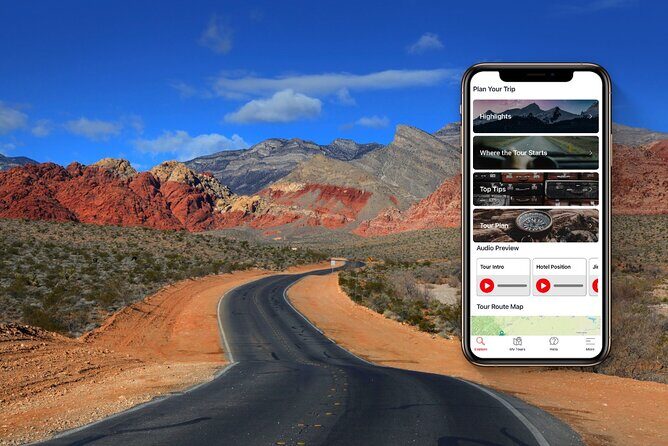
The audio tour itself costs $16.99 per group (up to 8 people in the vehicle). That’s important because a lot of sightseeing drives get expensive when you’re paying per person, especially in big areas like this where you’re driving a lot of miles.
Then there’s the separate entrance budget: $35.00 per booking for Grand Canyon West, Hoover Dam, and Red Rock Canyon. In other words, you’re paying once for the guided experience that runs on your phone, and you pay the site fees for the actual attractions.
This setup is good value if you like the freedom of a self-guided road trip, but still want the history and practical directions that make the day feel more complete.
Other Grand Canyon combo Hoover Dam tours we've reviewed
How the GuideAlong offline GPS audio keeps you on track
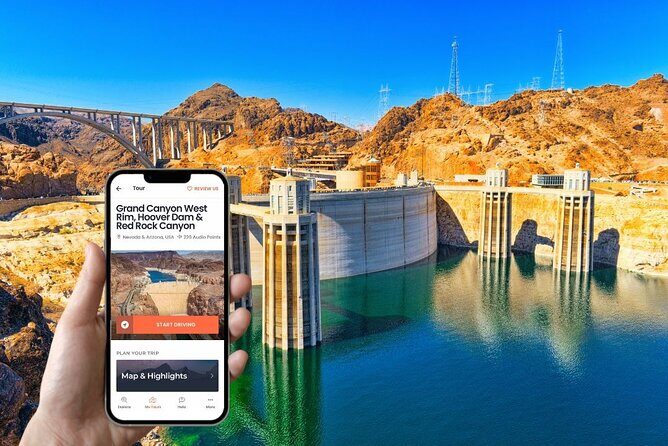
This tour uses the GuideAlong app (GuideAlong by GyPSy Guide). After booking, you’ll get a voucher redemption step by email/text, then you download the app and the tour under My Tours.
Here’s the practical part: during the drive, the audio isn’t just a playlist. It’s tied to your phone’s GPS, so stories, tips, and directions autoplay based on your location. That’s what helps the experience feel less like listening to random facts and more like having a guide in the car.
I’d treat setup like part of the trip. Download the tour while you have Wi‑Fi or cellular data, and then keep your phone charged. A USB/car charger is a smart move, because you’ll be using GPS and audio for hours.
A quick note on syncing
One recurring theme from real-world use: start the tour properly from the app while you’re near the starting area. If you begin after you’ve driven around a bunch, your GPS position may not line up as cleanly, and you might have trouble getting the narration to start where you expect.
Where to start in Las Vegas (and why it matters)
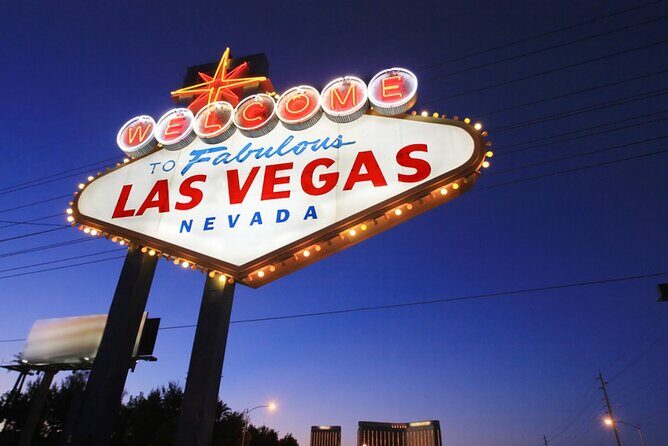
You begin on Las Vegas Boulevard South (Las Vegas Blvd S). The tour is designed so you can start and end along the route—meaning you’re not locked into a single tiny pickup point.
Opening hours are listed as 12:00 AM to 11:59 PM, Monday through Sunday for the active date window. Practically, that means you can build your plan around daylight for views, but you’re not forced into a narrow time slot.
If you want to keep this as painless as possible: get to the area, open the app, preview the route, then start the tour so GPS can lock in.
Stop 1: Las Vegas as your planning hub
This start is less about a single sight and more about your launch pad. Because the narration is location-based, Las Vegas becomes your staging point where the tour begins routing you into the correct sequence.
You can also use the in-app/web/PDF trip planners for half-day, full-day, or multi-day ideas. Even if you don’t follow them exactly, they help you choose whether you want to prioritize canyon viewpoints, dam architecture, or a calmer loop like Red Rock.
Other Red Rock Canyon Hoover Dam tours we've reviewed

Stop 2: Hoover Dam up close (and why the walk is the whole point)
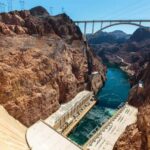
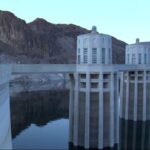
Hoover Dam is where the day starts feeling real. You’ll drive in for a roughly half-day style sightseeing stop, with an expectation that you park and walk onto the wall to appreciate scale.
This is one of those places where photos don’t fully capture what your body understands when you’re standing close to the structure. Take pictures from different vantage points around the dam so you catch both the engineering details and the bigger water-and-rock context.
The tour lists admission for Hoover Dam as not included in the audio portion. Budget for the site fee using the $35.00 per booking entrance bundle (which covers Hoover Dam as part of that group).
Stop 3: Hoover Dam Bypass bridge views with a science lesson
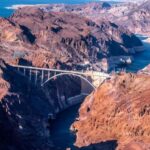
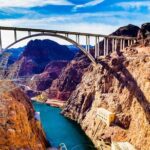
Right after Hoover Dam, you get a quick stop at the Hoover Dam Bypass—a modern arch bridge built to reduce the bottleneck problems along US 93.
Construction began in 2003 and finished in 2010. The bridge sits 890 feet (270m) above the Colorado River, and it’s described as the second highest in the United States.
It’s a short moment, but it adds a satisfying contrast: the old mega-project first, then the newer engineering solution right beside it. If you like how infrastructure stories connect across time, this stop pays off.
Stop 4: Grand Canyon West Skywalk (glass floor, big nerves optional)
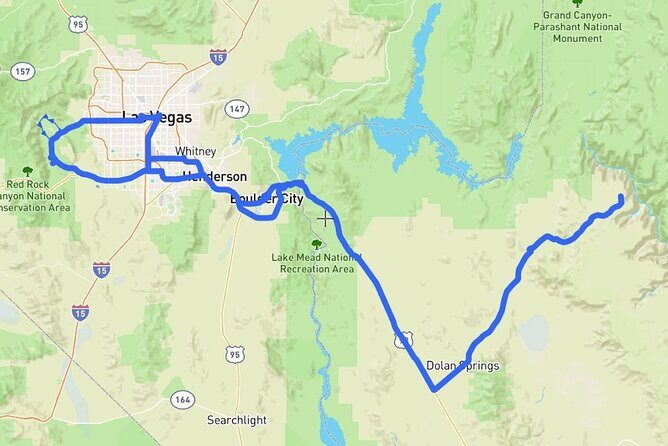
Grand Canyon West Rim sits on land associated with the Hualapai Nation. It’s close enough to Las Vegas to feel like a doable day trip, yet it still has that big-canyon punch.
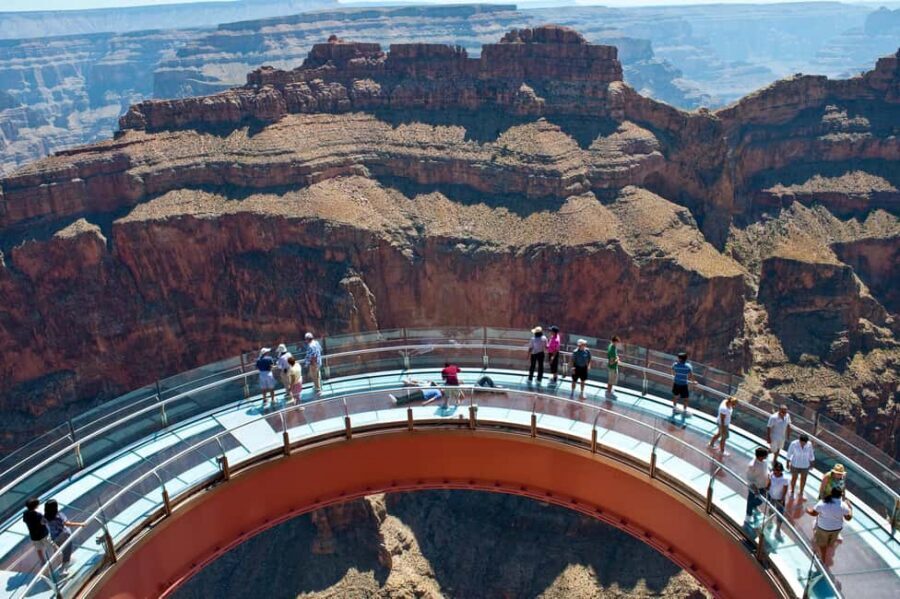
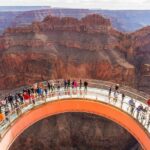
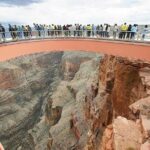
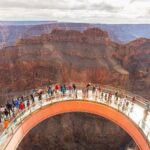
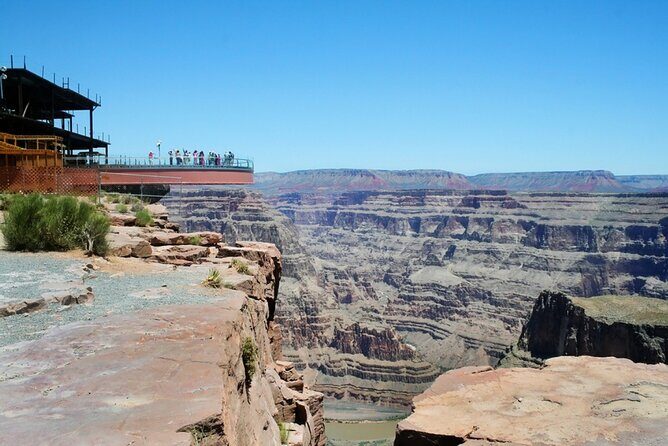
The star is the Grand Canyon West Skywalk: a glass-floored walkway that extends out beyond the rim. The design is U-shaped, and the key thrill is looking straight down through your feet to the canyon floor thousands of feet below.
Admission for the Skywalk is not included with the audio, so plan on paying the separate attraction system. The tour notes that the Legacy fee for the area includes shuttle access to Eagle Point, Guano Point, and the Ranch.
If you’re deciding where to spend your energy, I’d treat Skywalk as the headline. Then use the next two stops—Guano and Eagle—to stack extra viewpoints without overcommitting your time.
Stop 5: Guano Point—canyon views plus mining-cave texture
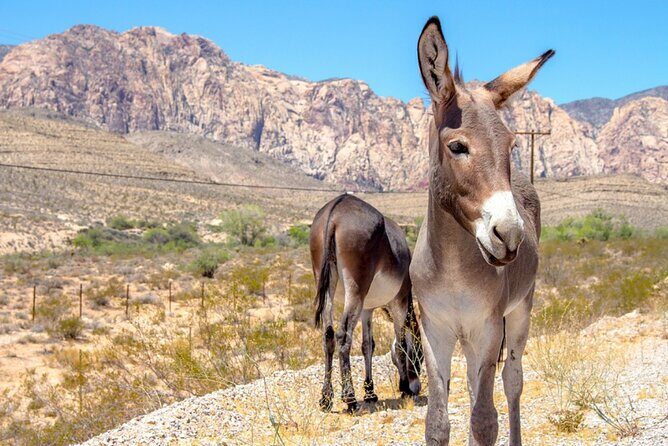
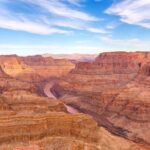
Guano Point is described as one of the best views even from the general viewing area. What makes it interesting beyond the standard postcard canyon look is the presence of caves tied to an old mining operation carved into the canyon side.
If you want a little more effort, there’s a relatively easy scramble mentioned to get an elevated view from atop a rock mound.
This is a great stop if you like variety: the canyon, plus a human history layer that isn’t just plaques and photos.
Stop 6: Eagle Point—legends in the rock shape
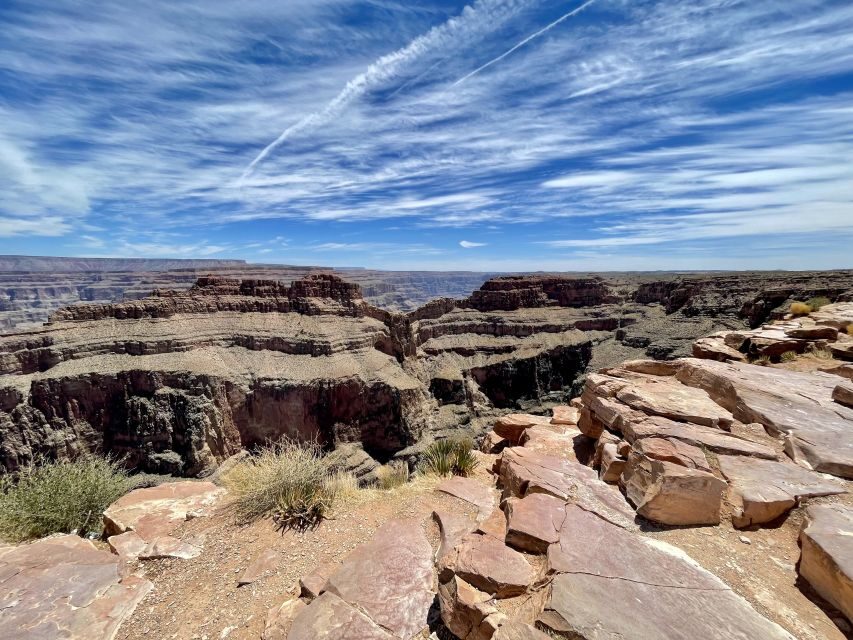
Eagle Point is another Hualapai Reservation-area stop, with a rock formation whose silhouette is said to look like an eagle with wings spread.
The tour ties this location to legends and sacred rocks, which gives you a different flavor than a pure geology stop. And the setting matters: it’s on the rim, so the view is the main event once you’ve taken in the shape of the rock.
Plan about 30 minutes here. That’s enough time to park your phone camera for a few shots and still leave you energy for Skywalk or Red Rock later.
Stop 7: Red Rock Canyon’s 13-mile loop (and the petroglyph bonus)
Red Rock Canyon National Conservation Area is a smart counterbalance after the Grand Canyon and the dam. Instead of one iconic structure, you get a 13-mile loop drive built for slow scanning and frequent pull-offs.
You’ll see red rock canyons, elevated viewpoints, startling formations, and ancient petroglyphs. There’s also mention of hiking and rock-hopping options, so if you like to stretch your legs, this is where you can do it.
The Red Rock Canyon Visitor Center adds value if you want context while still keeping it light. You can do indoor interpretive displays and then step outside to an interactive plaza.
This stop is about 3 hours in the tour timing. Budget admission accordingly, since the entrance bundle covers Red Rock Canyon as part of that $35.00 per booking group fee.
Stop 8: Spring Mountain Ranch State Park—history with real buildings
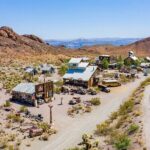
Spring Mountain Ranch is a preserved historical site and state park with some of the oldest building remnants in Nevada. The tour notes it has had famous celebrity owners through its history, and that living history and cultural programs take place.
What you get here is a palate cleanser from nonstop grand scenery. It’s also a good option if you want something more “human scale” after long drives and huge vistas.
Time here is about 1 hour. If you like parks that feel like places you could revisit with a picnic someday, this is the stop to remember.
Stop 9: Ethel M Chocolates Factory and Cactus Garden—sweet break, solid story
This is the practical rest stop you can justify emotionally. Ethel M Chocolates started as a retirement project in 1980 by Forrest Mars Sr. (yes, linked to the Mars candy empire), and it was named after his mother.
It’s also paired with a Cactus Garden, which makes it feel more like a short nature-and-snack stop than a drive-through gimmick. The tour lists admission here as free, so it’s an easy add-on.
Plan about 30 minutes. Enough time to reset before you head back out for viewpoints and the last stretch toward Boulder City and Lake Mead.
Stop 10: Lake Mead viewpoint—fast payback for a short stop
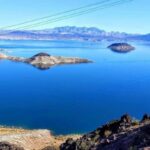
This is a quick one: there’s a superb elevated viewpoint along the Hoover Dam access road where you can enjoy expansive views of Lake Mead.
The tour connects the dots: Lake Mead was created by the backfilling of the dam. So even though it’s a short 10-minute stop, it helps you understand what the dam does beyond concrete and corridors.
Stop 11: Boulder City—planned housing, no gambling
Boulder City was built as a base for roughly 5,000 workers constructing the Hoover Dam. The tour describes it as meticulously planned and supervised, with restrictions like prohibiting alcohol and gambling to keep workers focused.
Today, you can still see historic buildings downtown, plus cafes, diners, and art studios. The key point: Boulder City is described as having no casinos now, and gambling is still not legal.
Time here is around 30 minutes—enough to get a sense of the town’s origins without turning it into another major attraction.
The best way to use the route planner (without turning it into homework)
The tour offers trip planners (in-app, web, and PDF) for different lengths of day. Use that as a starting point, not a contract.
If you’re time-limited: prioritize Hoover Dam plus one big Grand Canyon activity (Skywalk, then Guano/Eagle). Add Red Rock only if you’re staying flexible on timing, because it’s a full 3-hour loop.
If you have half a day and love quick wins: do Hoover Dam, the bypass stop, then pick one canyon viewpoint segment. If you do that, save Red Rock for another day so it doesn’t feel rushed.
If you want variety: add Spring Mountain Ranch and the Ethel M stop, then treat Lake Mead and Boulder City as light, story-based closures.
What I think this audio driving tour is best for
This works best for people who like to control the pace and who don’t need a group schedule to feel satisfied. It’s a strong match if you:
- want offline GPS guidance in a remote-feeling part of Nevada,
- like learning context while you drive,
- prefer a day built from stops you can linger at.
It may frustrate you if you expect the experience to behave like a tour bus with guaranteed synchronization and a guide standing next to you. The narration is great, but it depends on your phone’s GPS and on you starting the tour properly.
Also, keep your driving steady. One practical tip from real-world use: moving too fast can make you miss turns or cues, because the instructions are tied to your location timing.
Final call: should you book this audio tour?
If you’re visiting Hoover Dam, Grand Canyon West, and Red Rock Canyon and you want a low-stress way to connect the dots, I think this is a smart booking. The offline nature is the big win, especially when service can be spotty, and the location-based stories make the long drives feel purposeful.
If your travel style is mostly about walking with a live guide talking in real time, you might feel like something is missing. But for a DIY road trip with accurate guidance and a narrator like Raymond keeping things clear (and a bit playful), this is exactly the kind of add-on that can make the day feel richer without hijacking your schedule.
If you do book it, download everything on Wi‑Fi before you leave, bring a charger, start the tour near Las Vegas Blvd S, and then let the GPS narration do the work while you enjoy the scenery.